
Browse Posts by Date
Our Broadcast Partners
Category Archives: The Tales of a Stroke Patient
Something REALLY New to Help Stroke Survivors
I’m just taking a guess. I never met him. But Robert Thornton is probably one of those guys that you meet every so often because, as it turns out, he is a humanitarian. Sharon, his girlfriend, had a stroke on April 4, 2012, and as a result of the stroke, developed, among other things, a subluxed shoulder, common in stroke survivors. She had severe pain that was caused by the misaligned shoulder. First, a little history on subluxation so you can understand what Robert did.
Taking all the medical mumbo-jumbo out of the picture, the shoulder joint, a ball and socket formation, is the most flexible of any joint in the body. It also makes the shoulder the most unstable joint. In a subluxed shoulder, popular wisdom, in plain English, explains that the shoulder joint’s failure of the socket to completely cover the ball of the upper arm bone makes the shoulder reliant on soft tissue instead to hold it in position. When the upper arm comes substantially out of the shoulder socket, it allows for less mobility, and subluxation results.
With a shoulder subluxing, the patients sometimes feel a popping sound as the ball joint moves out of the socket then returns. Read more…
Babies and Strokes
This is a brain. It is also the unfortunate outcome of a baby whose mother experimented with cocaine, resulting in a premature birth and a bleed in the baby’s brain. A bleed in the brain means the baby had a stroke. Hey! Wait a minute! Babies and strokes don’t go together, or do they?
Note: for all you baby-makers out there, I’m not trying to scare you from having kids. This post is just a dose of reality.
You probably don’t know the name Duncan Guthrie. He started a charity in 1952 for his daughter, Janet, who had polio, and he was determined to find a cure for the disabling disease. With money funded by the charity, research, in time, led to the first oral polio vaccine which wiped out new cases of polio in the UK. Now called Action Medical Research, the charity encompasses so many other afflictions, and that leads us to babies and strokes.
In 2009, Action Medical Research estimated at least one baby out of 2,300 in the UK born full-term were victimized by a stroke. These strokes often were unexpected at the time of birth or before, i.e. some developing babies had strokes in utero. The researchers didn’t know if the babies, who are now barely three years old, had trouble using language because they hadn’t matured to the point where anybody could tell the difference between a three year old saying gibberish or not. Read more…
The Cancer Scare
I was scared of anything medical, even way before the stroke. I waited eleven years to get a sinus operation, ten years to get a colonoscopy, and eight years to get hearing aids. Then I broke my shoulder in December, but my upper arm was still swollen five months later. And, of course, I was worried. Could it be blood clots again, this time in my arm, closer to my heart? So I decided, at last, to take action. Five months. I’m improving with age.
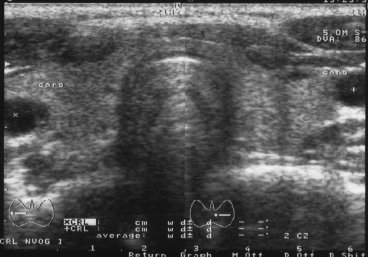
I went to the local imaging center in May, a chain that specializes in mostly MRIs, CT scans, ultrasounds, and X-rays. The technician scanned my arm with an ultrasound and told me that I didn’t have clots. The doctor verified the result in a letter. But what no one told me was the technician went up too far and scanned my thyroid, too. A few weeks later, I got another letter, recommending a biopsy because my thyroid had eight nodules, seven of them too small to worry about. The eighth one gave the doctor concern. I made another appointment as soon as possible which translated into three weeks, but a little background first on cancer and biopsies. Read more…
If You Squeeze Them One More Time, I May Hurt You.

Men basically have two things to worry about: erectile dysfunction and the prospect of prostrate cancer. Big deal. But most men don’t know what it takes to be a woman because they’ve never walked our mile. Permit me to elaborate: wearing a clumsy pad or a tampon that was pushed up too far while our 30+-year period continues to flow; achieving pregnancy with bipolar-ish hormones run through our veins; using itchy make-up, because it was the best buy, that was not tested on animals; losing our diaphragms somewhere, somehow, inside our bodies; experiencing the annual pap smear that will tell you if uterine cancer is in the cards; and, my personal favorite, getting a mammogram, especially after my stroke.
A mammogram is a bitch. Millions of women, including me, have to get a mammogram every year to detect, primarily, cancer and other breast disorders.
A mammography exam is a type of imaging that uses an x-ray, the low-dose type, to examine the breasts, called a mammogram, which is used to aid in the early detection and diagnosis of breast diseases in women. Other machines exist to capture the breasts’ images, but an x-ray is the most popular. If the doctor suspects a problem, you might use another method of scanning the breasts, like an ultrasound. Read more…
Strokes: False Facts and a Quiz
By now, so many months later, I’ve heard mostly everything that has been said about strokes, including upsetting rumors, dreadful untruths, and uplifting myths. Let’s take these issues one at a time. The comments in parentheses are mine. I’ll give you examples, too, even though it’s sort of painful to do so. But, hey. I’m here to teach you about strokes, so I’m obligated. But it’s so hard to hear that stuff, from people who just don’t know.
Upsetting rumors
When I was at Rehab X, I overheard (yes, I was eavesdropping) two stroke patients conversing.
“Could I get worse than this?”
“Sure. I heard from a nurse that sometimes, a stroke can turn into measles.” (Measles come from a virus. The nurse doesn’t know jack! The scary thing is, why doesn’t she know?)
Or this one, heard from a CNA:
“If you don’t brush your hair regularly, you’ll lose most of it.” (Hair loss comes about for many different reasons, and one of them is trauma. If you’re “out of the woods” as far as strokes are concerned, most likely your hair will grow back).
Dreadful untruths
Untruth: A stroke survivor who was giving a talk said, “Stroke patients die more often than not.”
Truth: Nope. Read more…
The Hospital Gown: Misguided and Malfunctioned
Country Music icon Trace Adkins sang “Honky Tonk Badonkadonk” at the Grand Ole Opry when I was in Nashville about a decade ago. The music was hot, but the lyrics left me wondering about Trace:
It’s so hard not to stare
At that honky tonk badonkadonk
Keepin’ perfect rhythm
Make ya wanna swing along
Got it goin’ on
Like Donkey Kong
And whoo-wee
Shut my mouth, slap your grandma
There outta be a law
Get the Sheriff on the phone
Lord have mercy, how’d she even get them britches on
That honky tonk badonkadonk
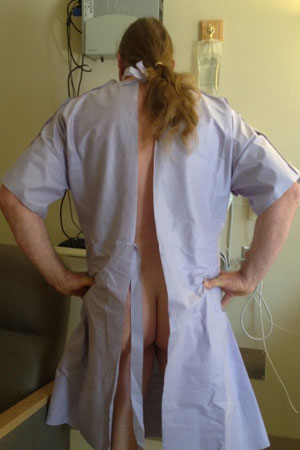
So when crazy-as-a-loon, slap-your-grandma, meant-to-do-it Trace tweeted a picture of himself wearing a hospital gown when getting his kidney stones blasted (tweets are generated by Twitter for all of you who know how to get on Facebook and not much else), the hospital gown had its back open, allowing you to see Trace’s bootie. His comment in the tweet was, “@ Vanderbilt having kidneys stones busted. No big deal.”
The big question is, why would he do that, being an icon and all. And why would anyone want to see Trace Adkins’ flat, skinny, sorry ass? I saw it and it wasn’t pretty. Not even close. (You can see it, too, if you want, at this link: tasteofcountry.com/trace-adkins-naked-butt-surgery-twitter/). Read more…
The Fall, And I Don’t Mean the Season | The Tales of a Stroke Patient | Joyce Hoffman
The biggest problem I had was with my body not functioning like it used to. I wasn’t walking independently, and sitting on a regular chair was a challenge. But that’s what the wheelchair was for. I didn’t need to walk–yet, and the wheelchair forced me to sit upright, even if the staff had to strap me in. But all systems were “go,” if you got my drift, and that was one less thing to worry about.
It was in the beginning of the fourth week at Rehab X that I had a problem that I couldn’t surmount. It involved a CNA (no surprise there) and getting up in the middle of the night. Your first question would probably be, “What was I doing up in the middle of the night?”
But if you really thought about it for a nanosecond, you will probably come with the answer: I had to go to the bathroom, and that was because I kept hydrated all day, so afraid my “peeing” would stop working again. That was MY idea, but the doctor assured me that wasn’t the case. I didn’t wholeheartedly believe him and I was incurring another problem: skepticism.
I awakened at 3am, even with my headset, to the sound of snoring. Read more…
ALERT: A Voyeur in the Nursing Home
I always wonder about people who do odd, compulsive things. Take voyeurism, for example. Voyeurism is French meaning “one who looks.” In popular wisdom, voyeurism occurs when somebody views or photographs or films others without their awareness. In common vernacular, voyeurism can be defined as “a peeping Tom.”
Now for some trivia on a non-trivial topic: In England, voyeurism became a criminal offense in 2004, if the subject didn’t know he or she was being viewed. In Canada, voyeurism became a sexual offense in 2005 by the same guidelines as England. In the United States, voyeurism can be both a criminal and sexual offense, and may have the guilty party register on the Sex Offenders List.
And there’s more. In Saudi Arabia, the sale of camera phones was banned for about a year because of non-consensual pics but reversed in 2005 only because cellular companies wouldn’t be able to offer complete 3G services if camera phones weren’t included. In South Korea, the government requires that all camera phones elicit an audible noise whenever someone snaps a picture. In places like Afghanistan and Iran, voyeurism can lead to, well, who knows. The point is, voyeurism is annoying, to say the least.
Sorry to say, I had my own experience with a voyeur at the nursing home. Read more…
The Top Ten Things You Should Never Say or Do to a Stroke Patient | The Tales of a Stroke Patient | Joyce Hoffman
People are funny, and I don’t mean in a ha-ha sort of way. They could be neurotic, bi-polar, obsessive-compulsive, anxious, or agoraphobic, just to name a few types. Some of the ones who came to visit me had their own type: dysfunctional-when-meeting-a-stroke-patient.
Even though they had good intentions, in all fairness to me, some of them said and did things that were downright insulting, if I took the comments and body language personally. But I didn’t ever, for those people who took the time and came to visit me.
In all fairness to them, how could they know the right responses from the wrong. What it really comes down to is this: How do you speak to a stroke patient whose had her life turned around in a 180-degree spin?
I made a list of the top ten things you should never say or do to a stroke patient, and I, too, have been guilty of most of them before having my stroke when I visited stroke patients. So having set the record straight, here goes.
1. Saying good girl, good boy, good job
Those are phrases you should say to your pets when they are being rewarded with a “Pup-Peroni” or Doritos’ chips. Read more…
How I Regained My Speech, Starting with Two Little Words | The Tales of a Stroke Patient | Joyce Hoffman
This no-talking situation was really starting to get to me, big time. I thought, What if I didn’t say another word for the rest of my life? What if I had to motion to things constantly and nobody paid attention? What if there was an emergency and I couldn’t call for help?
The what-if questions were making me anxious and depressed. I didn’t have one thought about what I should do. But then I realized something that shook my innards to the core. I was becoming invisible to others. And that feeling of invisibility, that I couldn’t go on this way forever, became my modus operandi to do something about it.
About three weeks into Rehab X, it was just about lunchtime and I had concluded my morning therapy. The Transport guy delivered me to my room and I nabbed a CNA to help me into bed. I was going to take a quick power nap before therapy would resume again. I could smell the food in the hallways but by this time, I had gotten used to not eating. I just applied another layer of Vaseline to my cracked lips–the same hand to squeeze the tube and apply it–when an LPN walked in unannounced. Read more…